Comparable Sales Data Accuracy in Valuations
AccuValu6 min read
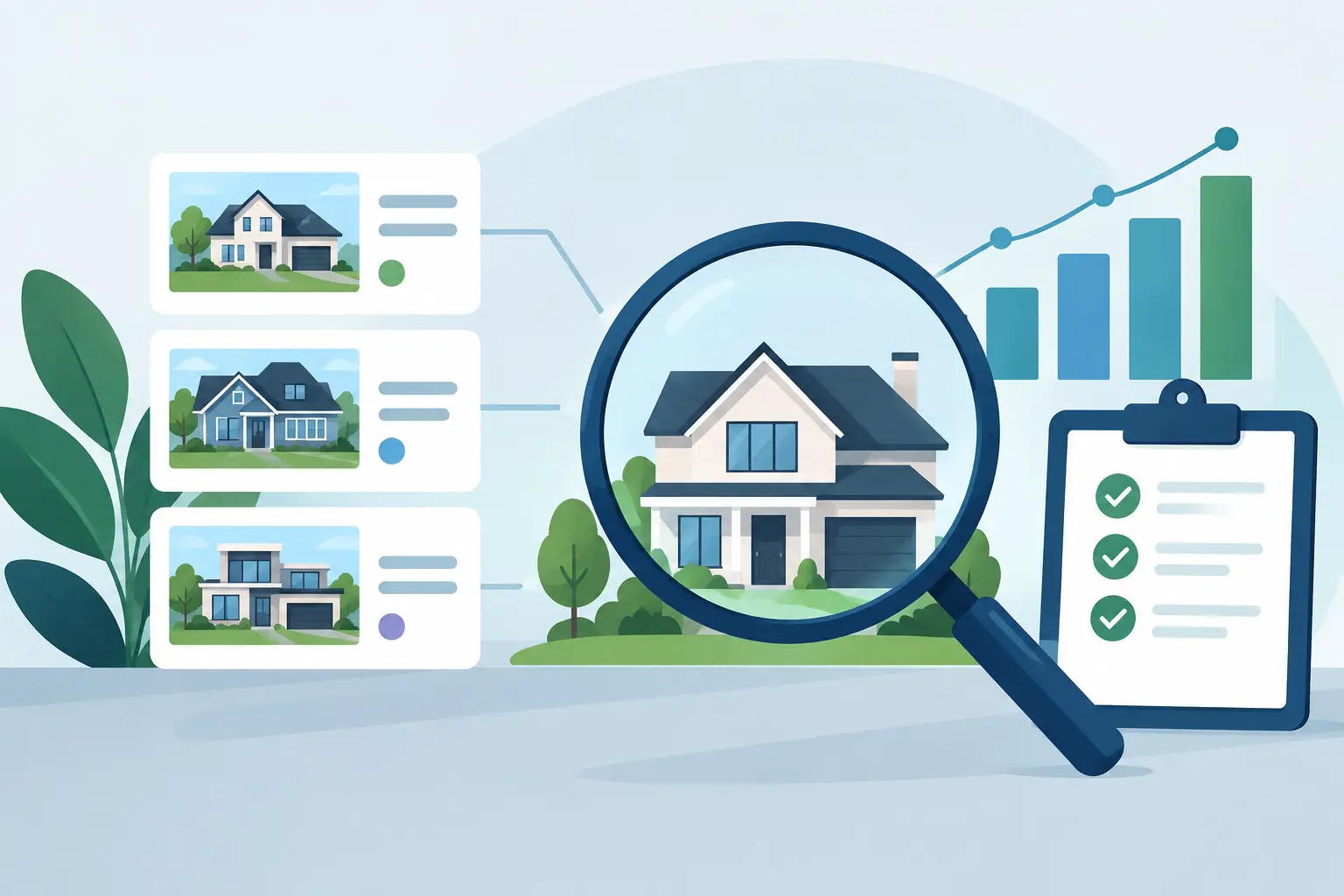
A CMA can look polished, include recent sales, and still point to the wrong price. The difference is often comparable sales data accuracy: whether the sales used, the property facts behind them, and the adjustments applied genuinely represent the subject property’s market position.
For real estate professionals, this is not a technicality. A pricing recommendation must hold up when a seller asks why one home was included, why another was excluded, or why the final range differs from an automated estimate. Precision-powered valuation begins with a simple standard: comparable sales should be relevant, verified, and analyzed in context.
What Comparable Sales Data Accuracy Actually Means
Comparable sales data accuracy is frequently reduced to a question of whether a sale closed recently. Recency matters, but it is only one dimension. Accurate comparable analysis depends on the quality of the underlying data, the relevance of each selected property, and the discipline used to account for meaningful differences.
A closed sale may be geographically close yet economically distant from the subject. It may sit in a different school assignment area, have superior views, include a renovated kitchen, or reflect a seller concession that distorts the recorded price. Treating it as a direct comparison simply because it is nearby introduces false precision.
Accuracy also means recognizing that public records, listing inputs, and transaction data can be incomplete or inconsistent. Living area, lot size, bedroom counts, condition notes, dates, and sale terms may not align across sources. Professionals need a process that identifies these discrepancies before they enter the valuation logic.
The objective is not to find identical homes. Identical homes are rare. The objective is to determine which sales offer the strongest evidence of what a well-informed buyer would likely pay for the subject property under current market conditions.
Why Data Accuracy Changes the Pricing Conversation
An inaccurate comp set creates risk at every stage of a transaction. It can lead to an overambitious list price that produces early market resistance, or an overly conservative recommendation that leaves seller equity on the table. Either outcome can weaken the client’s confidence in the advisor and complicate negotiations.
More subtle errors can be equally consequential. A property may appear to support a price target until a closer review reveals a materially larger lot, a finished basement, a premium location within the neighborhood, or a non-arm’s-length transaction. If those differences are not recognized, the CMA provides the appearance of evidence without the strength of evidence.
Accurate analysis improves the client conversation because it makes the reasoning visible. Rather than presenting a list of sales and a broad opinion, the professional can explain the market signals that matter: buyer demand, competitive alternatives, condition, location influence, feature premiums, and changes in pricing momentum.
That distinction becomes especially valuable in markets where inventory is uneven. When only a few recent sales exist, every selected comp carries more weight. In high-volume markets, the challenge is different: filtering a large data set without allowing superficially similar but economically irrelevant sales to influence the result.
The Three Dimensions of Comparable Sales Data Accuracy
Property-level accuracy
Property data must represent the home as it existed when it sold and as it competes today. A bed and bath count is not enough. Condition, effective age, renovation quality, functional layout, accessory spaces, lot utility, views, parking, and outdoor amenities can materially affect buyer behavior.
This is where manual review remains essential. Data can flag differences, but the professional must determine whether a difference has market significance. A remodeled primary suite may command a premium in one neighborhood and have limited incremental effect in another. The right adjustment is not universal. It depends on local buyer preferences and the evidence available in the market.
Market and location accuracy
Distance is a useful filter, not a measure of comparability. A sale two blocks away can be less relevant than one a mile away if the two locations serve different buyer segments. School boundaries, road exposure, neighborhood identity, walkability, topography, water access, and micro-market supply can all change value.
A precision-focused CMA evaluates location as a set of market influences rather than a radius alone. It also examines competitive positioning. Does the subject compete with the selected sale for the same buyer? If not, the comparison may require more adjustment than the data can credibly support.
Timing and transaction accuracy
A closed price is a historical observation, not automatically a current value conclusion. Market conditions may have shifted between the sale date and the valuation date. Changes in inventory, pending-sale activity, list-to-sale ratios, days on market, and price reductions can alter the relevance of a sale even within a few months.
Transaction terms deserve equal scrutiny. Seller concessions, personal property, distressed circumstances, estate sales, related-party transfers, and unusual financing terms can make a recorded sale price less representative of open-market value. The sale may still be informative, but it should not be treated as clean evidence without qualification.
Where Conventional CMA Workflows Lose Precision
Traditional comp selection often starts with a map search and ends with a small group of sales chosen under time pressure. That workflow can work for straightforward properties in stable neighborhoods. It becomes less dependable when the property is unique, the market is moving quickly, or the available sales include meaningful variation.
The common issue is not a lack of data. It is an inability to weigh data consistently. One agent may prioritize proximity, another may favor square footage, and a third may rely heavily on a home’s most recent list price. Each professional may be experienced, yet the resulting valuations can vary widely because the analytical framework is not standardized.
Generic automated estimates create a different limitation. They can process broad data sets quickly, but they may not explain why a specific local sale was considered relevant or how a condition difference affected the result. For a professional advising a client, an unexplained number is not enough. The recommendation needs traceable support.
Advanced analytics improve this process by organizing property and market variables into a more disciplined valuation model. The technology does not replace local expertise. It directs attention to the factors most likely to affect value, surfaces anomalies, and reduces the chance that a consequential data point is overlooked.
Building a More Defensible Valuation Process
A reliable process begins before the comp search. Confirm the subject property’s facts and document features that may influence buyer perception. This includes updates, deferred maintenance, layout constraints, site characteristics, and features that are common or uncommon within the competitive set.
Then evaluate candidate sales through layered filters. Start with market area and property type, then assess physical similarity, condition, location influence, timing, and transaction circumstances. Avoid forcing a sale into the analysis because it is close or because its price supports a preferred conclusion.
Next, test the comp set as a group. If one sale pulls the indicated range sharply higher or lower, identify why. It may be a legitimate signal of a feature premium, or it may be an outlier created by a data error, unusual terms, or a meaningful difference that has not been adequately measured.
Finally, present a value range rather than implying certainty where the evidence does not support it. A narrow range may be appropriate for a highly standardized home in an active market. A wider range may be more honest for a distinctive property with limited relevant sales. Precision is not the same as pretending that uncertainty does not exist.
Comparable Sales Data Accuracy Is a Professional Advantage
Clients do not expect agents to predict the future perfectly. They do expect a recommendation grounded in credible evidence and explained with confidence. When comparable sales data accuracy is treated as a core valuation discipline, the CMA becomes more than a listing presentation attachment. It becomes a defensible decision tool.
AccuValu’s approach reflects that shift: advanced analytics can bring greater consistency to the comparative process while preserving the professional judgment that local markets require. The strongest valuation work combines both - structured evidence and informed interpretation.
The next time a pricing decision feels uncertain, look beyond the number of comps collected. Ask whether each sale truly earns its place in the analysis. That question is where stronger pricing guidance begins.