Comparable Sales Analysis for Better Pricing
AccuValu6 min read
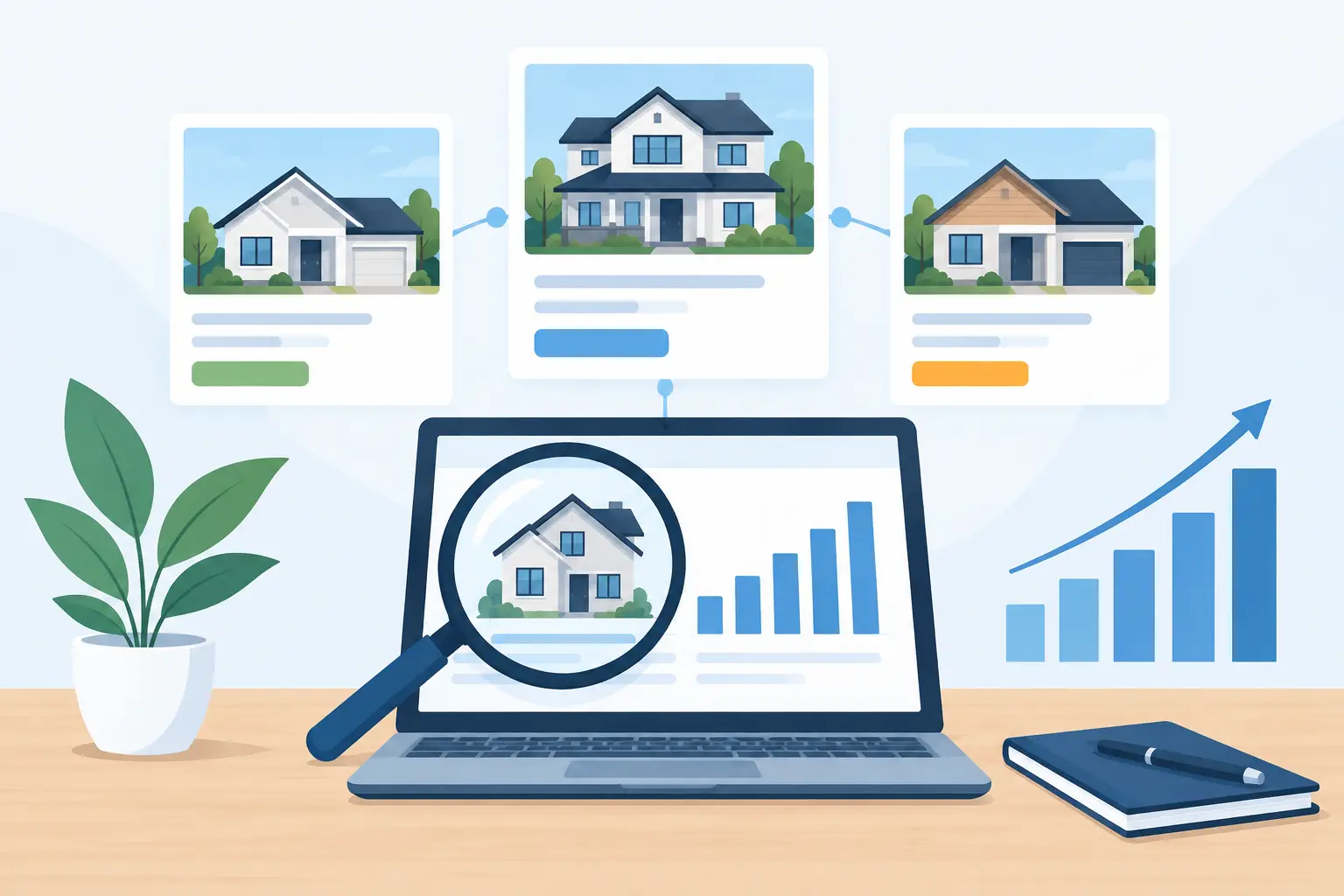
A listing appointment can turn on a narrow pricing gap. Price too high, and the property may lose early momentum. Price too low, and the seller can leave meaningful equity on the table. A comparable sales analysis is the disciplined process that turns local market evidence into a pricing recommendation that can stand up to that conversation.
For residential professionals, the goal is not to produce a longer comp sheet. It is to establish a credible opinion of value based on properties that genuinely compete with the subject home, adjusted for the factors that influence buyer behavior in the current market. That requires more than proximity, square footage, and a recent sale date.
What Comparable Sales Analysis Actually Measures
A comparable sales analysis estimates a property's likely market value by examining recent transactions and active competition. It is not an appraisal, and it should not be presented as one. Its value lies in providing a structured, market-informed basis for list pricing, offer strategy, pricing adjustments, and client guidance.
The analysis begins with a simple question: if a buyer were considering the subject property today, what other homes would they realistically compare it against? The answer is rarely limited to the closest three sales.
A strong analysis weighs location, property type, living area, lot characteristics, age, condition, design, bedroom and bathroom count, amenities, and sale timing. It also accounts for market movement. A sale from six months ago may be useful evidence, but it may not reflect current buyer demand, inventory levels, or financing conditions.
The result should be a reasoned value range, not a false promise of exactness. Real estate markets contain variation, and two buyers can assign different value to the same feature. Precision means reducing avoidable uncertainty through better evidence and a more consistent method.
Why Manual Comp Selection Creates Risk
Traditional CMA workflows often depend on manually filtering available sales, selecting a handful of records, and applying broad adjustments from experience. Professional judgment remains essential, but a process built primarily on manual selection can introduce inconsistency.
The most familiar risk is confirmation bias. When an agent begins with a desired list price, it becomes easier to favor sales that support that target and discount evidence that does not. A second risk is comparability drift: a property may be nearby and recently sold, yet differ materially in condition, school assignment, architecture, view, lot utility, or buyer appeal.
Time is another constraint. Reviewing every relevant record across a market area is impractical when pricing a new listing, responding to a lead, or preparing for a client meeting. Under pressure, professionals can default to simple distance and date filters. Those filters are necessary, but they are not sufficient.
Advanced analytics improve the process by applying consistent criteria across a broader body of market evidence. They do not replace local expertise. They give that expertise a more rigorous foundation.
Build a Better Comparable Sales Analysis
A reliable workflow follows a sequence. Each step narrows the gap between raw transaction data and a defensible pricing recommendation.
Define the subject property before searching
Start with a complete property profile. Verify public-record data against the home as it exists today. Capture the elements buyers will notice immediately: effective condition, renovation quality, functional layout, natural light, outdoor utility, view influence, parking, finished space, and location within the neighborhood.
This step matters because an incomplete subject profile creates weak comparisons from the start. A remodeled kitchen is not merely an amenity field. It can change the property's competitive position relative to otherwise similar homes.
Establish the real competitive market
Geographic boundaries should reflect buyer behavior, not just map distance. In some markets, a major road, school boundary, municipality, or change in housing stock can create a sharp value difference within a few blocks. In other markets, the appropriate competitive area may extend beyond the immediate neighborhood because buyers search across several adjacent communities.
Use recent closed sales as the primary evidence base, then review pending and active listings to understand present market pressure. Closed sales show what buyers have paid. Pending properties can signal where current demand is forming, while active listings reveal the alternatives buyers see right now.
Rank comparables by similarity, not convenience
The best comparables are not always the newest records or the nearest homes. A similar home sold slightly farther away can be more relevant than a nearby sale with a substantially different layout, condition, or buyer profile.
Similarity should be evaluated across multiple dimensions at once. A property can match the subject in living area but miss on lot quality. It can match in bedrooms and baths but differ in modernization. A credible analysis recognizes these trade-offs rather than treating every data point as equally informative.
This is where analytical scoring adds value. By evaluating a wider set of characteristics consistently, technology can surface stronger candidates and identify outliers before they distort the pricing story.
Account for market timing and transaction context
Sale price is evidence, not the whole explanation. Consider days on market, list-to-sale price ratio, concessions, financing terms when available, and whether the transaction appears atypical. A distressed sale, an unusually motivated seller, or a heavily negotiated closing may be valid market data, but it should not carry the same weight as a clean, competitive transaction without context.
Market conditions also affect how much emphasis to place on older sales. In a stable market, a larger date range may be appropriate. In a fast-moving market, recent activity deserves greater weight, and older evidence may require more careful interpretation.
Apply adjustments with discipline
Adjustments should explain meaningful differences, not manufacture a desired result. Avoid treating broad rules of thumb as universal. The value contribution of an extra bedroom, a pool, a view, or a renovation depends on the property segment and local buyer expectations.
When adjustments become large, pause and reassess the comparable itself. A sale that requires extensive changes to resemble the subject may be a weak anchor, even if it is close by. Several moderately adjusted, highly relevant sales often provide stronger support than one heavily adjusted transaction.
Communicate a range and the rationale
Clients do not need a spreadsheet without interpretation. They need to understand what the evidence says, what assumptions were used, and what could change the outcome.
Present a recommended range supported by the most relevant sales and current competition. Explain the pricing position: whether the recommendation is designed to test the upper end of the market, generate early activity, or align tightly with demonstrated buyer behavior. A clear rationale strengthens the conversation when a seller's expectation differs from the data.
Where Advanced Analytics Changes the Workflow
A modern valuation process does more than automate report creation. It organizes complex market information into a repeatable analytical framework.
Advanced analytics can evaluate larger sets of potential comparables, identify patterns that are difficult to see in a limited manual review, and apply consistent weighting across property attributes. That improves speed, but speed is not the central benefit. The real advantage is greater consistency in how evidence is selected, evaluated, and communicated.
AccuValu is built around this principle: comparative market analysis should function as precision-powered valuation intelligence, not a static collection of selected sales. The professional still supplies market knowledge, property context, and strategic judgment. The analytical layer makes those decisions more transparent and easier to defend.
There are limits. No model can fully capture a home with singular architecture, an exceptional setting, or a highly localized buyer pool without informed professional review. Data quality also matters. When property records are incomplete or a renovation is not reflected in available data, on-the-ground knowledge remains decisive.
Turn Analysis Into a Stronger Pricing Conversation
The strongest pricing recommendation does not claim certainty. It demonstrates command of the evidence. It distinguishes between a home's features and the features buyers are currently rewarding, between a hopeful list price and a supportable market position, and between a generic estimate and a professional opinion.
Before presenting a CMA, ask whether the selected sales would make sense to an informed buyer touring the subject today. If the answer is unclear, the analysis needs another pass. Better comparable sales analysis creates better questions first - and those questions lead to pricing decisions clients can understand and trust.